
Accessing the Product Editor
-
Log in on desktop and navigate to Dashboard
-
Go to Products > All Products

-
Select any product you’d like to edit
This opens the product editor with several key tabs. Let’s walk through each one.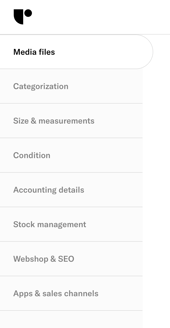
📸 1. Media Files
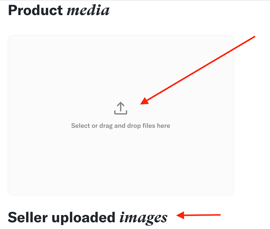
This section shows all uploaded images.
-
Drag and drop images to reorder them
-
Move your preferred front image to the top position
-
Seller Uploaded images shows at the bottom and be used as image library for product if no other images are uploaded by you.
🗂️ 2. Categorization (Product Taxonomy)
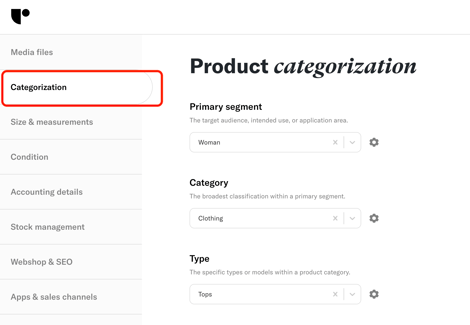
Categorization follows Ribbn’s taxonomy tree structure:
-
Primary Segment → e.g. Woman
-
Category → e.g. Clothing
-
Type → e.g. Jeans
-
Style → e.g. Wide leg
Other fields include:
-
Brand
-
Color
-
Material
If you’ve uploaded a product taxonomy or used Ribbn's default taxonomy, this will help autofill the data. AI will also support auto-completion based on your upload method.
Need a recap or help setting this up ? See: Product Taxonomy System
📏 3. Size & Measurements
This section maps your product to Ribbn’s Size Taxonomy, which standardizes sizing for better shopper filtering.
-
Measurement Category: Choose the product category
-
Label Size: What the tag says (e.g. 42, Medium)
-
Standard Size: Convert to standard size (we chose S/M/L to be the general standard size type)
-
Fit Remark: Notes like “Runs small” or “Oversized”
-
Detailed Measurements: Choose cm or inches
-
Fields shown depend on the measurement category chosen at top (e.g. Jacket vs. Pants)
-
If fields look wrong, double-check your category selection
-
📖 More on sizing? Read our article on Size Taxonomy
✅ 4. Condition
-
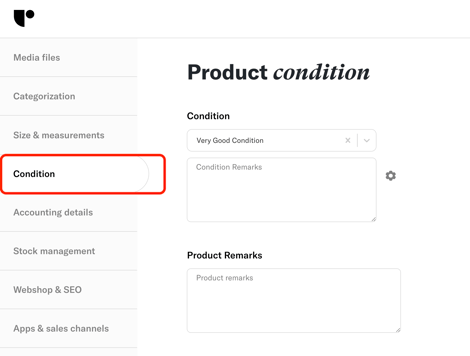
Condition: New, Like New, Good, etc.
-
Condition Remarks: Optional notes
-
Product Remarks: Any defects, damage, or comments
-
Care Instructions: Include wash or material-specific advice
💰 5. Accounting Details
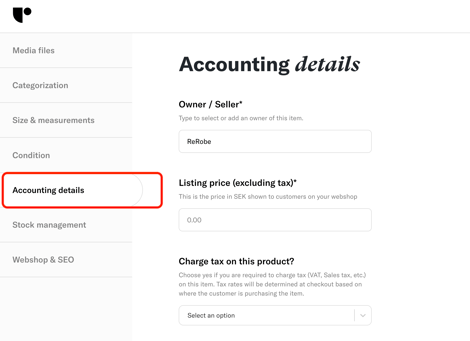
Ownership & Commission
-
Owner / Seller: Map the product to the correct seller
-
If you own the product (e.g. bought it into stock), list yourself
-
-
Your Commission: Enter as a decimal (e.g. 0,5 = 50%)
Pricing
-
Listing Price: Input the price excluding tax
-
If you're required to charge VAT (moms), see next section
-
-
Charge Tax on this product:
This toggle helps sellers indicate whether a product is subject to taxation (such as VAT, Sales Tax, moms, etc.). It ensures that tax regulations are met automatically, based on where the customer is located when they check out.
-
- If Yes, input the net price in Listing Price
- Example: Final price = 100 SEK with 25% tax → Listing Price = 80 SEK
- At checkout, VAT is auto-calculated based on buyer location
- If Yes, input the net price in Listing Price
-
-
If No, input the final price in Listing Price
-
Example: Final price = 100 SEK without VAT that should be added → Listing Price = 100 SEK
-
-
💡 Smart pricing engine handles tax display dynamically.
Not sure what to do? Read more about How to charge VAT on a product
Other Price Fields
-
Cost Per Item: Your acquisition cost
-
Original Price (optional): Former retail price, shown in product listing
-
Seller Suggested Resale Price: The original Listing price you offered the seller
-
Year Purchased: Useful for price benchmarking
📦 6. Stock Management
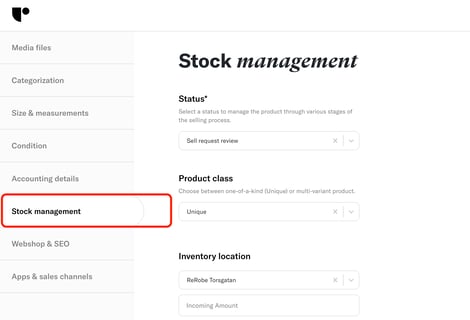
This section controls inventory tracking, logistics, and physical product handling.
-
Status *:
Select a status to manage the product through various stages of the selling process. This helps you track where the product is in your workflow, for example Sell request review.
-
Product Class:
Choose whether the product is one-of-a-kind or has multiple variants. Most resale items should be set to Unique, meaning there is only one available unit.
-
Inventory Location:
Select where the product is physically stored, for example ReRobe Torsgatan.
You can manage stock across multiple locations and track:
-
-
Incoming Amount
-
Available Amount
-
Use Add another inventory location if the item is stored in more than one place.
-
-
Weight Unit:
Set the unit used for weight calculations. Choose between Kilograms, Grams, Ounces and Pounds. This should be set to KILOGRAMS to ensure correct shipping rate calculations.
-
Weight Range:
Select the weight range of your product to ensure precise shipping cost estimations for your online sales, for example 0.5 - 1.0.
-
Weight, kg
By default, this field is populated with the upper limit of your selected weight range. You can override this by entering the exact product weight instead, for example 0,5.
-
RFID Tag
RFID tags are assigned using the Ribbn mobile app. If a number is showing here it means the product is linked to an RFID. This can also be used for QR codes.
-
SKU, Optional
Enter a custom SKU if you use internal product codes or need to sync with external systems.
-
Tags
Use custom labels to further categorize and organize your product inventory. You can select existing tags or create your own.